 24 Hour Towing South Bend
- Home
- Emergency & RoadsideEmergency TowingLocal TowingJump StartsTire ChangesFuel DeliveryLockout Service24 Hour TowingSame Day TowingRecovery & LoadingFlatbed TowingWinch Out / Vehicle RecoveryAccident RecoveryOff-Road RecoveryAbandoned Vehicle RemovalHeavy & CommercialHeavy Duty TowingSemi Truck TowingBox Truck TowingRV & Motorhome TowingSpecialty VehiclesMotorcycle TowingClassic / Exotic Car TowingElectric Vehicle TowingOtherLong Distance TowingJunk Car RemovalAffordable TowingView All Services →
- Blog
- FAQ
- About Us
- Contact
Electric Vehicle Towing 101: Why EVs Need a Flatbed, Not a Hook
If you drive an electric vehicle and you’ve never needed a tow before, here’s something worth knowing before you do: towing an EV the wrong way can cause real, expensive damage to your car — and it’s not obvious why unless you understand how these vehicles actually work under the surface.
The Wheels Are Never Fully Disconnected
In a gas-powered car, you can shift the transmission into neutral and the wheels spin freely, mechanically disconnected from the engine entirely. In an electric vehicle, the electric motor stays mechanically connected to the drive wheels even when the car is completely powered off. That constant connection is exactly why a standard hook-and-tow, which drags the drive wheels along the ground, isn’t a safe option for most EVs.
Regenerative Braking Turns Towing Into Charging
Regenerative braking is the system that lets an EV recapture energy when you slow down, using the electric motor as a generator instead of relying purely on friction brakes. If the drive wheels are forced to spin while being towed on the ground, that same regenerative system can activate on its own — generating electricity the car’s control systems aren’t ready to manage, since the vehicle is powered down and unable to safely direct that energy anywhere.
What That Can Actually Damage
Uncontrolled voltage generated by a spinning motor during towing can fry sensitive inverters, damage fast-charge circuitry, or place real stress on the battery pack itself — none of which are simple or cheap repairs. Every major EV manufacturer, including Tesla, Ford, GM, Rivian, Hyundai, and Nissan, requires flatbed transport with all four wheels fully off the ground for exactly this reason, and towing an EV incorrectly can void the vehicle’s powertrain warranty entirely.
Why Flatbed Towing Solves the Problem
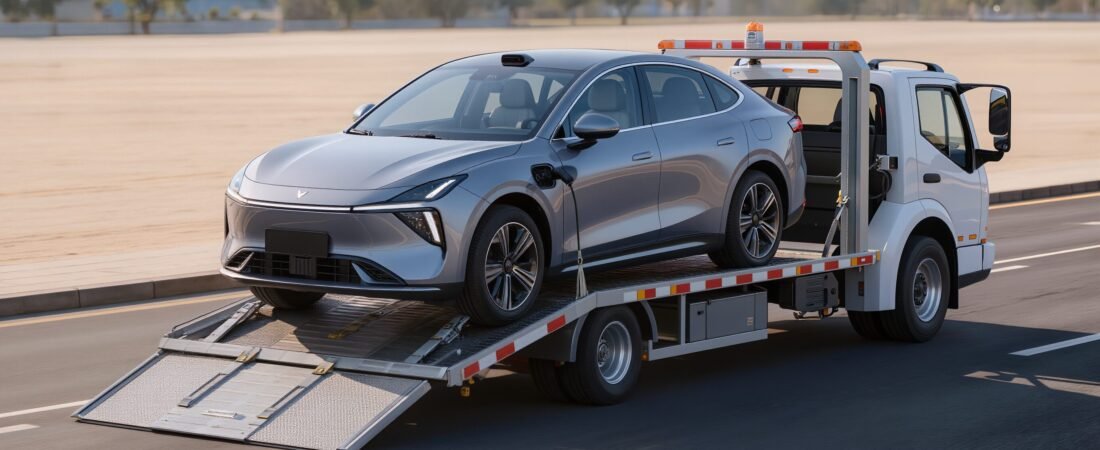
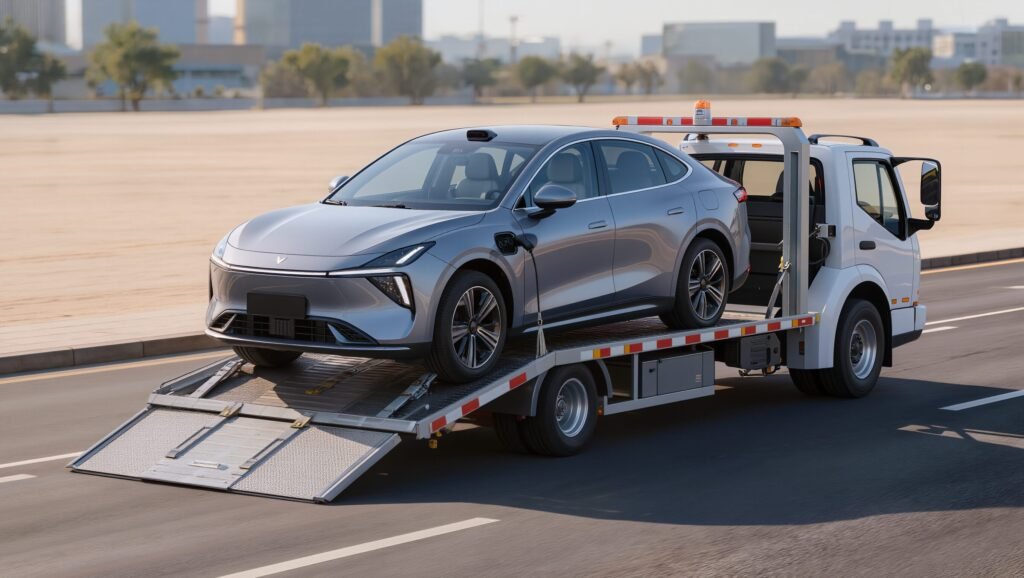
A flatbed tow truck lifts the entire vehicle completely off the ground, so no wheel ever turns during transport, regardless of the distance. No wheel rotation means no regenerative braking activation, no unexpected voltage generation, and no risk to the motor, inverter, or battery pack — which is exactly why flatbed is the only method manufacturers actually approve for towing an EV any real distance.
What to Tell the Dispatcher
If you drive an electric vehicle, say so clearly when you call for a tow. It changes which specific truck gets dispatched and how the driver approaches loading your car — a detail worth mentioning upfront rather than discovering, once the truck arrives, that it isn’t actually equipped to tow your vehicle safely.
Common Questions
Driving an EV That Needs a Tow?
We run flatbed equipment built for it. Contact us and let us know your make and model.